
Metaphormosis
Your paradise, or hell, within

Many tend to think of metaphors as poetic devices — the domain of literature, music, or romantic speech.
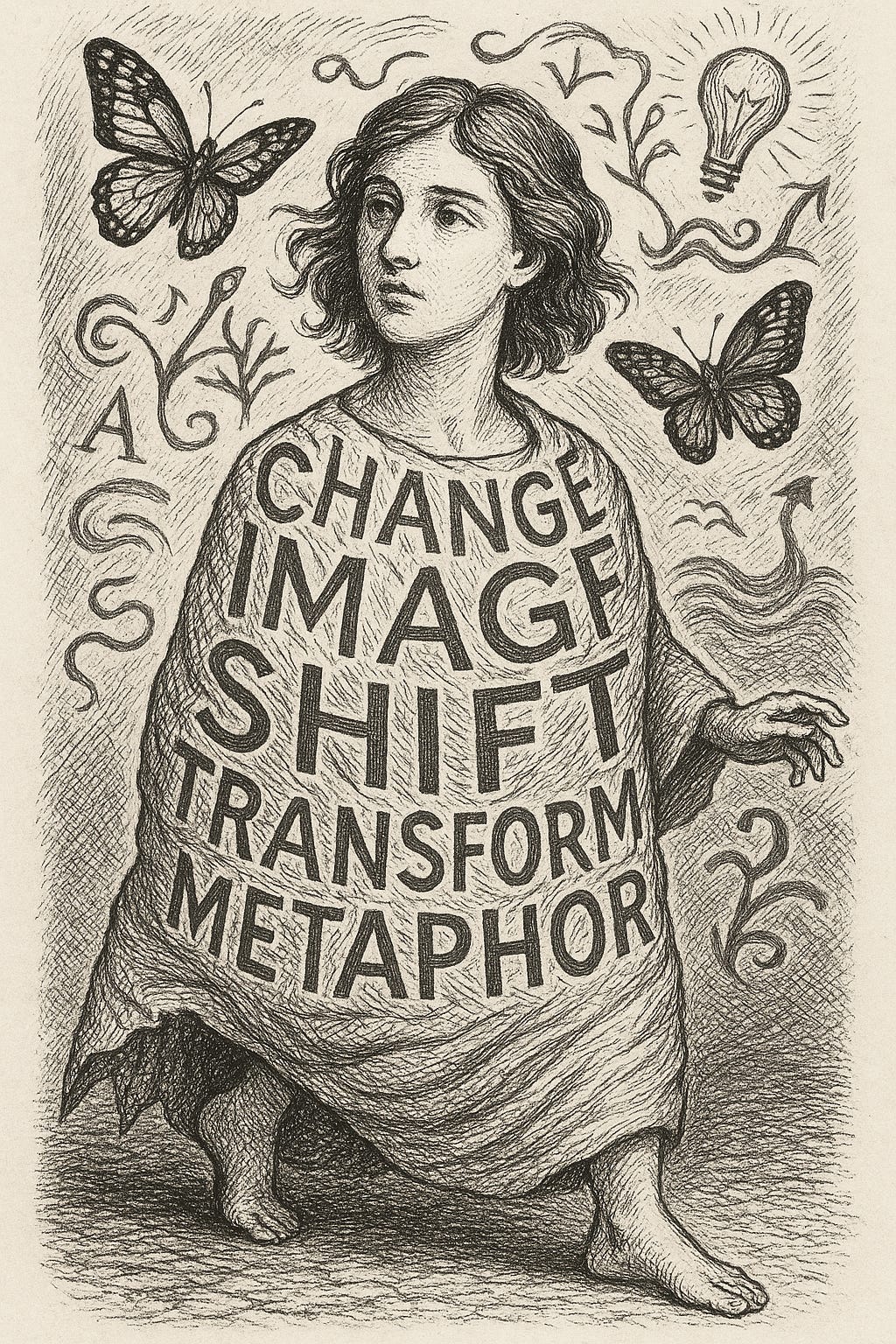
What if metaphor is much more, what if metaphor is how we think — how we communicate pain, identity, experience, and truth — long before we learn to give them names. If putting ”words” on them is even possible.
In neuroscience, metaphor is not fluff. It’s structure. It is the core pudding. It is the neurotransmitter connecting the executive function with the reptile brain…
In therapy, metaphor is not detour. It’s access, connection and possibly resolution. When that darkness of the mind gives way to a ray of hope, or the lump in the chest dissolves and butterflies of hope flutter below.
In science, metaphor is not simplification. It’s translation of complex and invisible concepts into cells and spirals. The simplifications that make these concepts seem graspable.
The Brain is a Story-Maker — Using Metaphor to Survive
An article in Frontiers in Pain Research, co-authored by my colleague Matt Hudson, describes how metaphors are central to how patients understand and express pain. Phrases like “burning,” “tight,” “stabbing,” or even “a black cloud” aren’t mere word choices — they are neurological maps. They give form to something that otherwise defies the inobvious limits of language.
When researchers or clinicians ignore metaphor — or treat it as imprecise — they risk losing the patient’s actual experience. Conversely, when they engage with metaphor on its own terms, they gain access to a world of meaning that can’t be measured, but can be translated, shared, and healed.
In Clean Communication, Metaphor Is a Portal
In my therapeutic work with Clean Communication, I treat metaphor not as ornamentation, but as structure-revealing language. When someone says “It feels like I’m walking through mud,” or “I carry this like a stone in my stomach,” I don’t replace it with a diagnosis or an interpretation. I follow it. I trust it. We explore what kind of ”mud” that mud is, and what would ”stone” want to have happen, next. Because every metaphor and emotion is a messenger.
In metaphor, a person is already halfway toward understanding, locating, and sometimes re-organizing their inner experience. Transforming their subjective ”hell” into more of a ”paradise”.
Changing the Metaphor, Changes the Self
This is the core insight.
Metaphor doesn’t just describe. It shapes, inspires and informs.
When someone shifts from saying “I’m under water” to “I’m learning to breathe in a new climate”, that isn’t just poetic. It’s neural. It’s cognitive. It’s metamorphic. It nudges the subconscious to look for a snorkel.
In fact, the process deserves its own word:
Metaphormosis — the process of identity transformation through the evolution of metaphor.
This isn’t just useful in therapy. It matters in education, in science communication, in conflict resolution.
If I describe someone’s worldview as a wall, I relate to it differently than if I see it as a maze.
If I call my grief a hole, I might want to fill it.
If I call it a river, I might wish to learn to float.
When people say they are ”working” on themselves — and I cannot say how often I hear this — I often say
It’s not a ”job” to be ”you”
There is no ”boss” no ”salary” no ”union” and no ”HR”. And, you cannot get ”fired” or ”look for another job”. Or have a ”vacation”.
Lousy metaphor in my world. Bad metaphor. Bad. Sit!
What if you are on a lifelong adventure exploring yourself. Daring to bring yourself boldly where no part of you has gone before. Dancing with your potential.
Science, too, depends on metaphor
As George Lakoff and Mark Johnson famously wrote, “Our ordinary conceptual system is fundamentally metaphorical in nature.” Even in physics and biology, we rely on metaphor to think:
“Genetic code”
“Chemical bonds”
“Neural networks”
“The immune system is a defense army”
These metaphors shape how we study, treat, and teach. They are invisible epistemologies. And when they go unquestioned, they can limit progress. When examined, they can open new paradigms.
Metaphormosis Is the Hidden Engine of Change
So whether you’re a clinician, a teacher, a leader, or simply a person trying to understand yourself and the world — notice your metaphors. Everyones.
Yours.
Others’.
Society’s.
Because when metaphor shifts, reality follows.
We don’t need better labels.
We need better metaphors — and the courage to water them curiously.
That’s not decoration. That’s metaphormosis.
When you think of it now, what is it, like?